
Most teams try to fix performance by pushing people to work faster. That usually fails.
The real problem is often not speed. It is flow.
Work gets stuck between departments. Decisions wait for approval. Priorities change. Information arrives late. Teams stay busy, but progress slows down.
A bottleneck is not always the person doing the work. Sometimes it is the system around them.
A simple example
Imagine a project that takes 12 days to complete. The actual work only requires 6 hours. Where did the other 11 days go?
They disappeared into:
- Waiting for approval
- Missing information
- Unclear ownership
- Rework
- Competing priorities
- Too many handoffs
This is why measuring activity alone can be misleading. A busy team can still have a broken process.
The FLOW bottleneck check
Use this four-step check when work is moving too slowly.
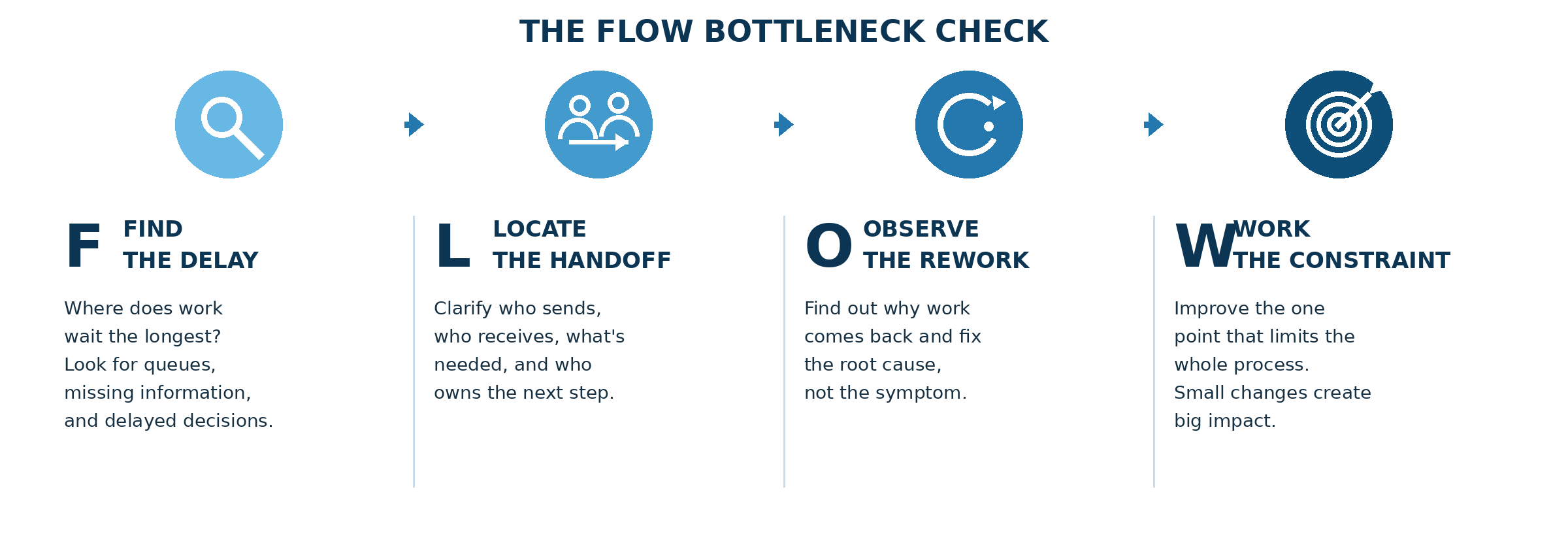
F: Find the delay
Ask: where does work wait the longest? Do not start by asking who is slow. Start by asking where work stops.
Look for:
- Approval queues
- Unanswered emails
- Incomplete requests
- Delayed decisions
- Work waiting for another department
L: Locate the handoff
Most process failures happen between people, not within individual tasks. Ask:
- Who sends the work?
- Who receives it?
- What information must be included?
- What happens when something is missing?
- Who owns the next step?
Every unclear handoff creates delay.
O: Observe the rework
Rework is one of the most expensive forms of waste because it looks like productivity. Ask:
- How often does work come back?
- Why was it rejected?
- Were the expectations clear?
- Was the request complete?
- Did the customer change the requirement?
Do not accept "communication issue" as the root cause. That is only the starting point.
W: Work the constraint
Once you identify the bottleneck, do not try to improve everything. Fix the one point that limits the entire process. You may need to:
- Create a standard intake form
- Clarify approval authority
- Set a response deadline
- Remove an unnecessary approval
- Assign one clear owner
- Build a visual queue
- Limit work in progress
Small changes at the constraint can improve the entire system.
Test your process
Score each statement from 0 to 2, then add up your total.
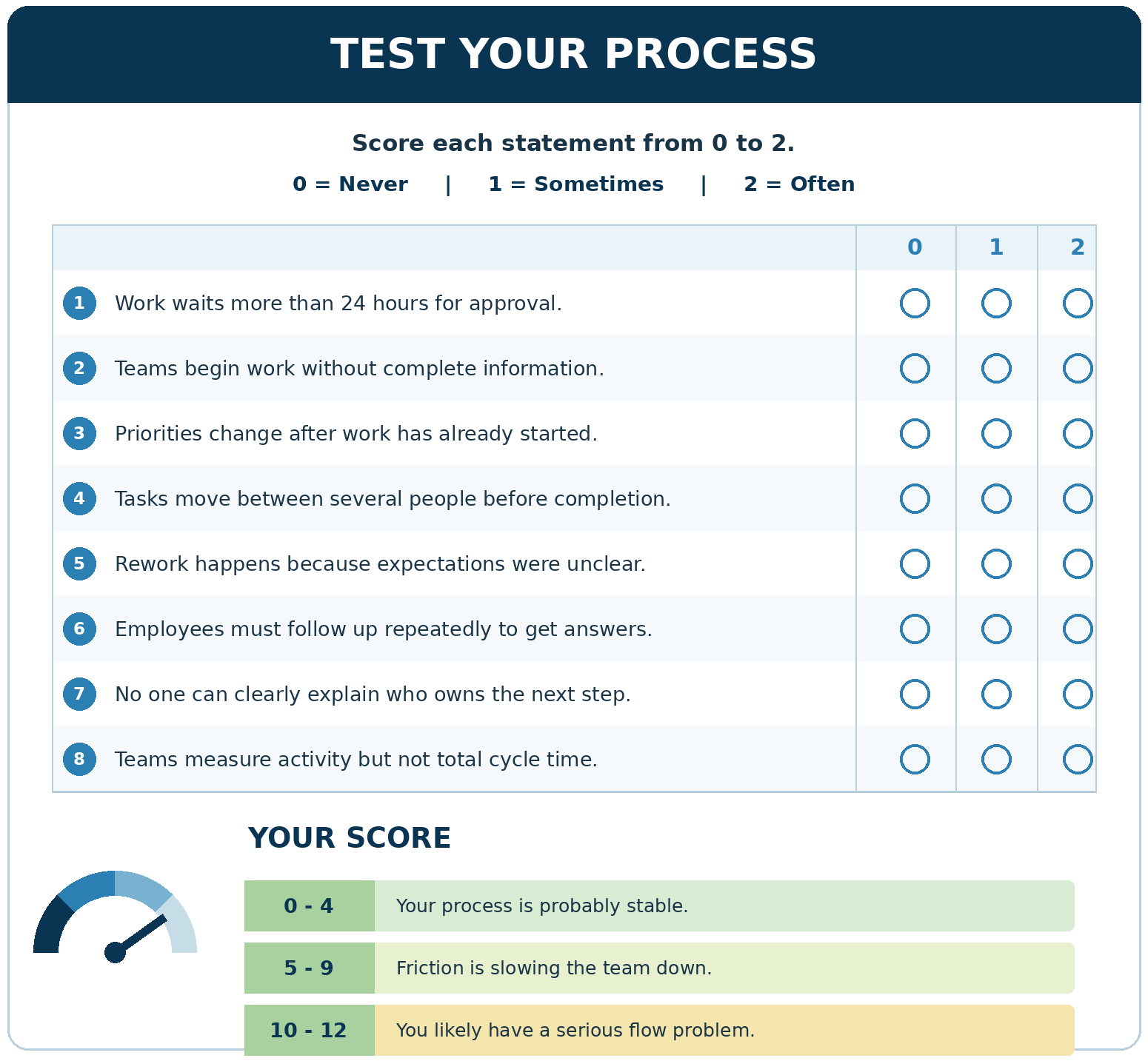
If you score 13 to 16, your team may be working hard inside a broken system.
A high score does not mean your employees are failing. It means the process needs attention.
Try this tomorrow
Choose one recurring process. It could be:
- Purchase approvals
- Customer complaints
- Engineering requests
- Hiring
- Order fulfillment
- Project intake
- Maintenance requests
Then write down four things:
- When does the process begin?
- When is it truly complete?
- Where does work wait?
- Why does it wait?
Do not redesign the entire process. Fix one delay. Measure the result. Then improve the next constraint.
The leadership lesson
Strong leaders do not only ask people to work harder. They remove the barriers that prevent good people from doing good work.
Before adding another meeting, another person, or another tool, ask: where is the work getting stuck?
That question may reveal more than another performance report.
Your move this week
What is the biggest bottleneck in your organization right now? Approval delays, unclear ownership, poor handoffs, or something else?
Share it in the comments.
Lior Zaken
I build, run, and grow operations. Marketing + Engineering + Ops.