Most teams fix a problem once. Then it quietly comes back.
A control plan stops the relapse. It turns "we improved it" into "we control it." Here is the 12-minute version you can copy and run today.
Step 1: Pick one process
Choose one workflow you touched recently. Examples: intake requests, handoffs, approvals, purchasing, scheduling, quoting. Keep it small. Win fast.
Step 2: Name the failure mode
Write the one thing that keeps breaking.
- Requests show up with missing info.
- Work gets started with no owner.
- Rework keeps repeating.
- Deadlines slip without warning.
- Approvals stall.
Step 3: Add 3 controls
One early signal. One process check. One outcome metric.
1. Leading indicator (early warning)
Catches drift before it becomes a fire.
- Percent of requests missing required fields.
- Percent of tasks started without a DRI.
- Number of "blocked" items older than 48 hours.
2. Process check (did the step happen?)
Protects the standard.
- Intake form completed before work starts.
- Owner assigned before kickoff.
- Approval recorded in the system.
3. Outcome metric (did it work?)
Proves the impact.
- Rework rate.
- Cycle time.
- On-time delivery.
- Overtime hours.
Step 4: Set a cadence
Keep it light. Keep it consistent.
- Daily: 2 minutes, look for drift.
- Weekly: 10 minutes, spot check and fix.
- Monthly: 30 minutes, reset targets, remove friction.
Step 5: Define triggers
If it crosses the line, you act. No debate.
- If missing info rate is over 10%, work pauses until corrected.
- If a task is unowned for 24 hours, it escalates to the team lead.
- If cycle time increases 15% week over week, run a quick 5 Whys.
Step 6: Assign one owner
One name owns the control plan. One backup supports it. No committees.
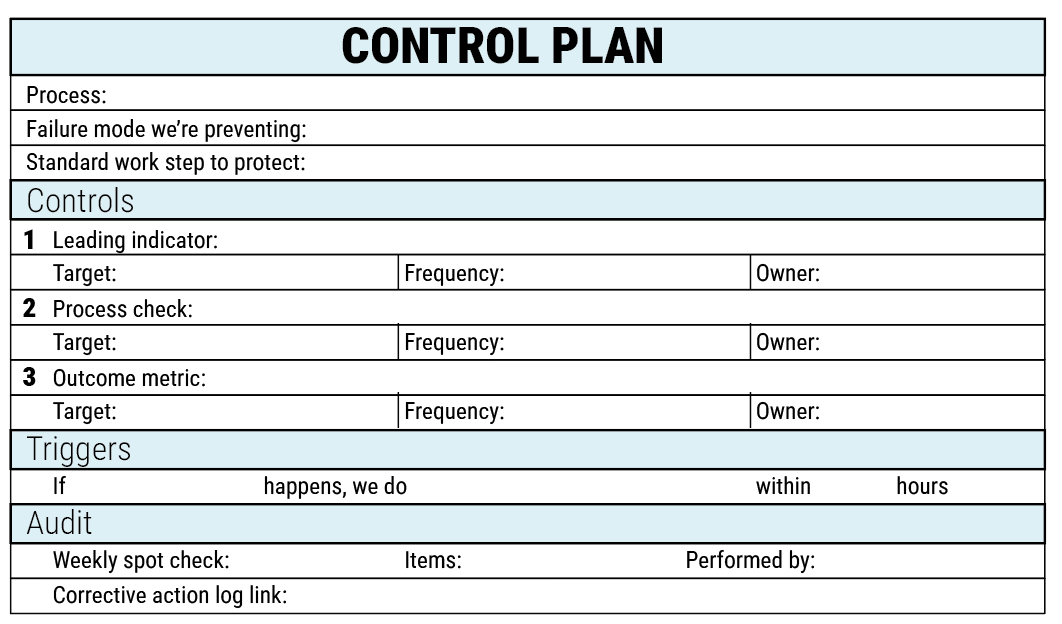
Copy and paste: the control plan
One page. Fill it in and pin it where the work happens.
Stabilize the gain
This is a core continuous improvement control. You do not "fix and forget." You stabilize the gain.
Lior Zaken
Operational Excellence & Continuous Improvement