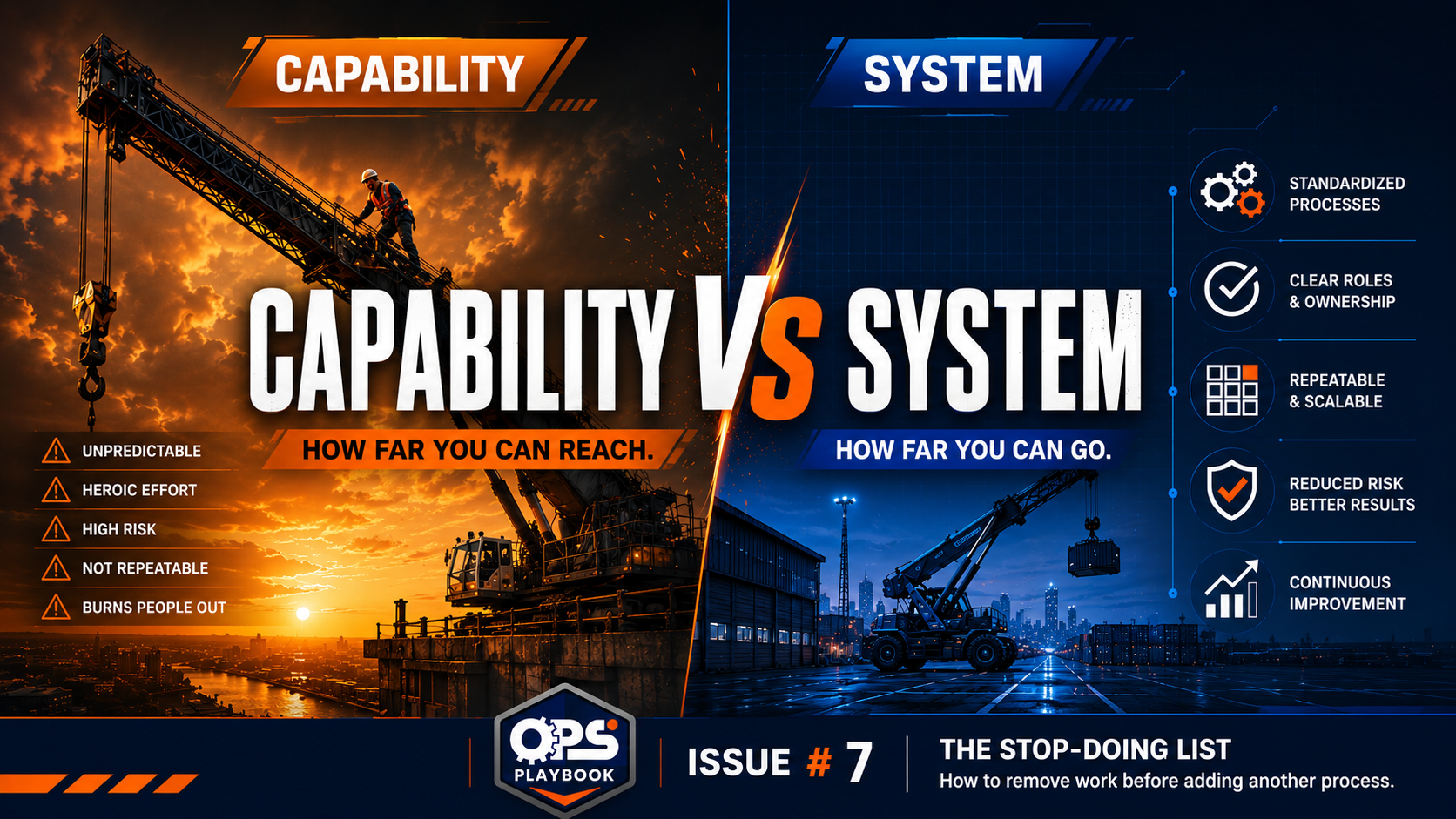
I watched a video this week of a machine doing something impressive. Big reach, smart design, the kind of clip that gets thousands of likes.
And my first thought was not "wow." It was "can it do that on a bad day?"
Because there is a gap most people miss. A capability is something that works once, in good conditions, when the right person is watching. A system is something that works every time, even on the worst day, with whoever is on shift.
That gap is where most operations quietly break.
The trap
Teams fall in love with the capability and forget to build the system around it. Someone figures out a clever fix. It works. Everyone celebrates. Three weeks later the same problem is back, because the fix lived in one person's head, depended on perfect conditions, and was never made repeatable.
- The star employee who can untangle any mess, until they are on vacation.
- The workaround that saves the day, until the one person who knows it leaves.
- The process that runs great in a calm month, until volume doubles.
Impressive once. Unreliable forever.
The shift: from "can we do it" to "can we control it."
A capability answers: can we do this? A system answers: can we do this every time, safely, with whoever is here, even when conditions are bad?
The crane that extends far is a capability. The crane that extends far and controls load, ground conditions, counterweight, and structural limits, that is a system. Same reach. Completely different reliability.
A real example
The capability: one experienced lead could clear a backlog fast by reprioritizing on the fly. Everyone relied on it.
The hidden dependency: it only worked when that lead was there and had time. When they were out, the backlog exploded.
The system version:
- Write the reprioritization rules in plain language anyone can follow.
- Add a gating check so junk requests never enter the backlog.
- Define the failure line: if the backlog crosses X, it escalates automatically.
- One owner for the standard, and a weekly check that it is followed.
Same capability. Now it runs without a hero.
The five steps
Any capability becomes a system the same way. Five moves.
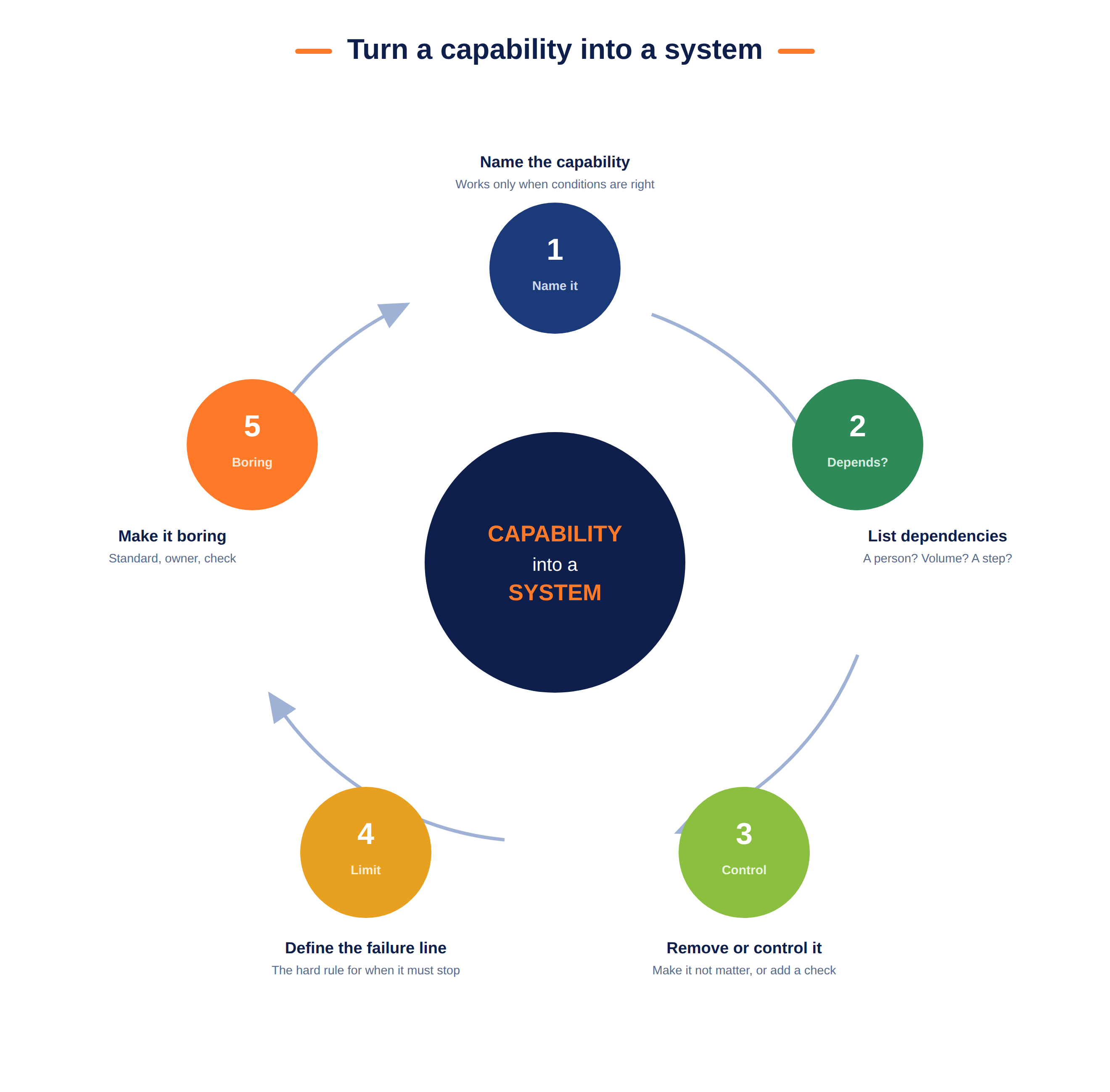
- Name the capability. The thing that works only when conditions are right.
- List dependencies. A person? Volume? A step?
- Remove or control it. Make it not matter, or add a check.
- Define the failure line. The hard rule for when it must stop.
- Make it boring. Standard, owner, check.
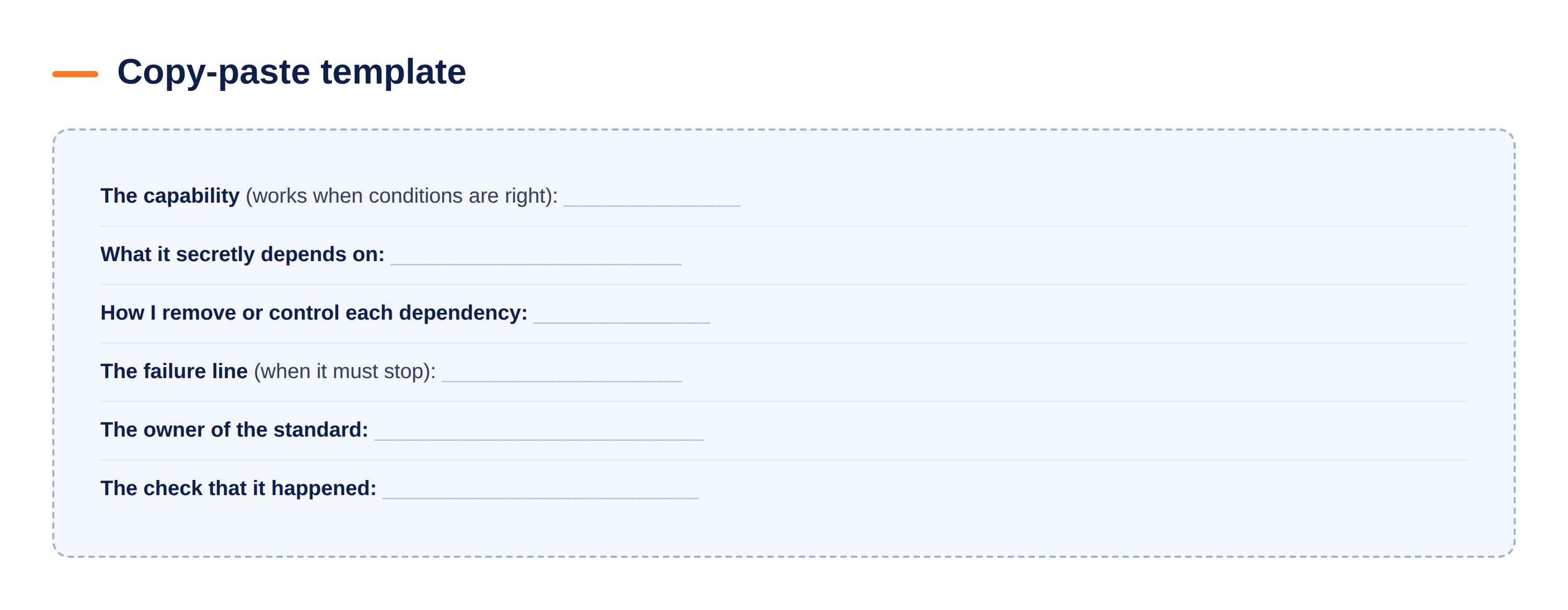
Copy-paste template
Fill this in for one capability and you have the start of a system.
Your move this week
Find one capability your team quietly relies on, the thing that works great until the right person is out or conditions turn bad. Run it through the five steps and turn it into a system.
If you do, comment "SYSTEM" and tell me the capability you are making repeatable. I will reply with the first dependency I would attack and how.
Lior Zaken
I build, run, and grow operations. Marketing + Engineering + Ops.